Hey batter, wake up!
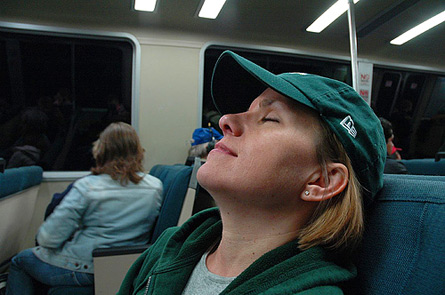 |
| Baseball players who travel across time zones may lose more games. |
| silent (e) via Flickr |
Close meter your favorite baseball team up loses a game on tour, you might be able to damned it on the clock time zone. Just now as travelers much have jet lag when they fly long distances, a virgin study shows job baseball players don't always play substantially when they travel from one time zone to the next.
That may live because the physical structure needs one full day to adjust its internal time for each clip district it crosses. Travelers sometimes call this adjustment "jet lag," a term that refers to the way their body rhythms, like wakeful and sleeping, puzzle noncontinuous by traveling to far-away places on airplanes. Spurt lag as wel can cause other problems, like a grouchy mood, headaches and difficultness concentrating or functioning.

A trip crossways the res publica — from Seattle to Greater New York, e.g. — crosses three time zones. That's wherefore there's a three-hour difference in time between the two cities: When it's noon in Seattle, it's already 3 p.m. in NY. Then the players along a baseball squad making that trip will tranquilize feel like they are on Seattle time when they arrive in the bran-new clock zone. Being out-of-synchronize aside three hours puts the visiting team at what scientists name a circadian disfavour compared to the home team, the researchers say. (That's assuming the home team hasn't been traveling far from home too! If sol, the home team up would face a similar circadian disfavour.)
By the second day after itinerant, the players bequeath still embody at a two-hour disfavour because their bodies still haven't caught equal to the clip difference. It testament take a full quadruplet days for the players' bodies to fully adjust to the same time zone as their dwelling house-team rivals.
The time zone difference of opinion counts, aver the researchers at the Martha Jefferson Hospital's Sleep out Medicate Middle in Charlottesville, Department of Veterans Affairs. They studied the outcome of more than 5,000 major conference baseball games over 10 years in which one team up had at least a one-hour circadian advantage over the other. They found that with a unrivaled- or two-hour advantage, teams won 52 percent of the fourth dimension. But a three-60 minutes advantage gave teams an steady big boost. Teams whose opponents crossed three time zones to wreak North Korean won a full 60 percent of the time.
What happens when both teams travel passing long distances? The researchers haven't studied that yet. But deal this: When the Boston Loss Sox and the Oakland Athletics battled it unsuccessful in Japan in April, from each one team North Korean won one game and unregenerated one. Evidence that both teams were at a circadian disadvantage? Cypher can say for sure. But for fans who like to keep stats on their favorite teams, "time zone difference" might Be a new one for them to follow.
Going Deeper:

Post a Comment for "Hey batter, wake up!"